Emergency relief fund
When you
reach out,
we reach back.

Emergency relief fund
How We Help section
Over the years, our nonprofit funds have been used to pay for essentials like groceries, clothing, and medications, the cost of rent, utilities, lost wages, and more. Our grants are available year-round, and applications must be submitted within six months of an unforeseen crisis. We want everyone to feel comfortable asking for help during difficult times.
How You Qualify section
Types of crises include:
If you have any doubts about whether you qualify, please email us at casemanagement@southernsmoke.org.
We understand that every situation is unique and may not be listed here. Are you a business owner, self-employed, or an agriculturalist providing goods or services for the food and beverage industry. Please see our Frequently Asked Questions (FAQs) below for more information.
What We’ll Need From You section
Our application requires:
We understand the process can be daunting, and your Southern Smoke case manager is here to support you throughout. We only ask for what we need, and we do not share information or report to other agencies. This is a completely confidential process.
What You Can Expect section
A caring human thoroughly considers every detail of requests. We build relationships with each applicant and stay in close communication throughout the process.
Funds are scaled to fit each situation. Don’t be afraid to tell us what you need.
The Emergency Relief Fund is open year-round. Applications must be submitted within six months of the unforeseen crisis date. Eligible individuals and households can receive one grant every 12 months, and up to two grants in a four-year period. Deadlines for natural disasters are established based on impact.
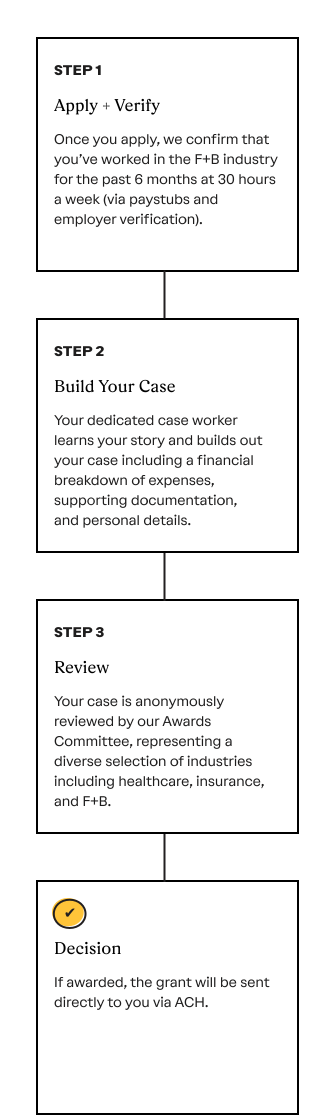
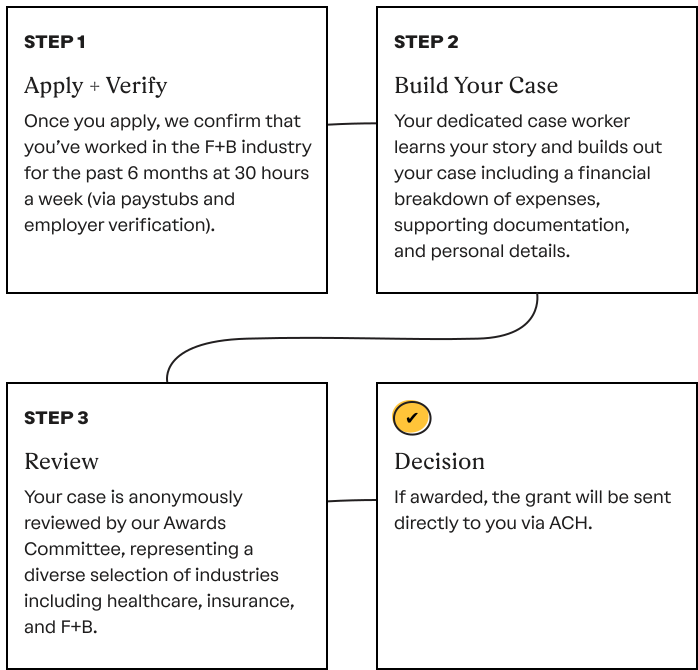
We provide funds as quickly as possible based on need and the collection of all necessary documentation and information. See the application timeline below.
The application process is completely anonymous. Only the Southern Smoke case management team will see an application in its entirety.
If you do not meet the qualifications to open a case, we will explain the reasons and inform you if or when you should reapply. We’ll also point you to additional trusted resources that can help.
Find answers to common questions below.
We support F+B workers in various roles across the industry. Eligible positions include chefs, line cooks, barbacks, bartenders, baristas, servers, food runners, general managers, dishwashers, coffeeshop workers, and shift supervisors. It also includes farmers and ranchers who supply food service establishments. Additionally, distillery workers, vineyard workers, beverage distributors, winemakers, sommeliers… the list goes on. Southern Smoke Foundation was created to support everyone who makes this industry possible, from QSRs to Mom and Pop shops, Michelin-starred restaurants, and everything in between!
To qualify, applicants must currently be employed in the food and beverage industry, working a minimum of 30 hours per week for at least six months. Additionally, the unforeseen crisis must have occurred within the six months prior to your application date.
A trained case manager builds each applicant’s case confidentially using verified employment, financial details, and crisis documentation. Completed cases are reviewed by an anonymous awards committee. Approved grants are distributed swiftly, with award amounts tailored to individual needs to help individuals stabilize and recover quickly.
Yes! Eligibility is determined based on financial need, not hourly/salaried status. Assistance is provided based on individual circumstances and assessed by how urgently the unforeseen crisis has compromised the household’s ability to cover basic living costs.
No! Workplace contribution status has absolutely no impact on eligibility.
Yes, the application process is completely confidential. Only the dedicated case management team will ever see your application in its entirety. We only ask for the specific information needed to verify your case, and we do not report your situation to outside agencies. Applicants may choose to grant us explicit permission to contact their employers directly, which may help expedite the employment verification process. Keep in mind that employment documentation, including paystubs, is required to process all applications.
Emergency relief assistance is determined based on individual need and available SSF resources.
Housing & Household Stability
Transportation Support
Health & Medical Support
Change of Circumstance
Mental Health & Wellness
Each application is reviewed on a case-by-case basis, and funding is determined by the applicant’s demonstrated need and the eligible expenses that Southern Smoke Foundation can support. Our goal is to provide meaningful assistance that helps applicants regain stability in the wake of an unexpected crisis.
Eligible applicants can receive:
Large-scale crisis, including natural disaster:
Grant frequency:
Yes, this is a very real need, especially in this industry. Through our mental health program, Behind You, we provide no-cost mental health counseling for F+B workers in California, Colorado, Florida, Illinois, Louisiana, Maine, Massachusetts, Michigan, New York, North Carolina, Pennsylvania, South Carolina, Tennessee, Texas, Virginia, and Washington, D.C. Those who live outside of the service states can apply for financial assistance for mental health crises through our Emergency Relief Fund.
The Behind You program provides access to 20 no-cost mental health counseling sessions for all eligible food and beverage workers.
You don’t need to be in crisis to be in counseling. Food and beverage workers that live in Behind You states can apply to our Behind You mental health program. Eligibility includes working at least 30 hours per week with a six-month work history, and earning taxable income.
All you need to do is share the website: southernsmoke.org. This includes applications to both programs. We can also share resource folders and materials to hang in your restaurant. Our Southern Smoke team members are available to set up pre-shifts or present at employee orientations to share more about how the program works and what to expect.
Yes! For Emergency Relief Fund assistance, we do not provide grants for business-related costs. Instead, we can assist individuals who own or operate F+B businesses with personal expenses, ensuring their lights stay on at home. If an owner/operator has experienced an unforeseen crisis, related or unrelated to the business, that has led to personal financial instability, and has been in operation for over twelve months, and meets our qualifying criteria, they are eligible to apply for assistance. Qualification criteria vary by business. To ensure your business meets our qualifications, we require proof of income and documentation to verify your business.
Since 2015, we’ve distributed more than $16.5 million to an incredibly diverse and deserving group of F+B workers across the country. Take a look at our Impact Map.